
Understanding Blocked Sewer Lines and Their Causes in Bangalore
A sewer line is the underground pipe that carries waste from every drain in your building to the main sewer or tank, and Chandu Drainage Cleaning clears a blocked one in a 5-step mechanised visit. Same-day attendance across Bangalore, with a free inspection and a quote before work starts.
Waste rising in the chamber or backing up through floor traps usually points to the shared line below your building, not one fixture. Our sewage cleaning service in Bangalore works from Rajarajeshwari Nagar. This guide covers what to expect, what it costs, and when cleaning is not enough.
At A Glance
- Price: Quoted after a free inspection
- Response time: Same-day visits, including nights and Sundays
- Method: Suction and high-pressure jetting
- Areas covered: All of Bangalore
- Contact: Call or WhatsApp 9900822778
What Is a Sewer Line and Where Does It Run?
Your sewer line is the buried pipe that takes everything from toilets, kitchens, and bathrooms away from the building. It runs through your chambers towards the main sewer or your septic tank, so a problem at one point stops every fixture upstream.
Most of the pipe sits underground, which is why people only notice it when something goes wrong. Gravity does the work, so the pipe is laid at a slope and meets an inspection chamber at each junction and bend.
Those chambers matter for two reasons. They are where a technician can see whether waste is moving, and they are where heavy solids settle first.
Houses, apartment blocks, PGs, hotels, offices, and industrial units all rely on the same basic layout. Only the scale changes, and with it the volume of waste and the speed at which a blockage builds.
A typical run carries:
- Toilet waste from every floor
- Water from bathrooms, kitchens and washing machines
- Grease, hair and silt that travel with the flow
- Sanitary waste and small debris that should never have been flushed
How Is the Main Waste Pipe Different from a Drain, Chamber or Septic Tank?
A sewer line is the main waste pipe serving the whole building, while a drain serves one fixture or one area. Chambers are the access points along the run, and a septic tank is the end point that stores and settles the waste.
The difference decides which job you book. If only the kitchen sink is slow, you need to drain the work. If waste rises at several points, the shared pipe or the tank downstream is the real problem.
In an apartment block, one pipe serves every floor, so a blockage low shows up on the ground floor first. Ground-floor flats see waste rising well before the upper floors notice anything.
| Part | What it does | Typical sign of trouble | Job, it needs |
| Fixture drain | Serves one sink, shower or floor trap | One slow outlet | Jetting or rodding |
| Sewage pipe | Carries waste from all fixtures | Several outlets back up | Suction and jetting |
| Chamber | Gives access and traps silt | Standing water under the lid | Desludging and washing |
| Septic tank | Stores and settles waste | Overflow and smell | Pumping and desludging |
Chambers fill first, so a choked chamber often looks like a pipe problem. Checking both is the quickest way to find where the flow actually stops.
Is It a Sewage Blockage or A Damaged Pipe?
A sewage blockage is waste stuck inside a sound pipe, and cleaning removes it. Damage is a crack, a collapsed section, or a displaced joint. A blocked sewer line usually stays clear once cleaned, while a damaged one blocks again within weeks.
Damage shows up as a pattern, while a blockage is a one-off event. Watch for these clues:
- Repeat blockages in the same line within a few months
- Wet patches or sinking ground above the buried pipe
- Flow that stops at the same chamber every time
Our guide to the seven warning signs of a damaged pipe lists the symptoms in full. When repair is needed, we say so plainly and quote for it, because jetting a cracked pipe buys time, not a fix.
The same team rebuilds broken chambers and replaces collapsed pipe sections through its masonry and civil work, so one call covers both the cleaning and the repair.
What Should You Do Before The Crew Arrives?
Stop using water in the building, keep people and pets away from the overflow and call as soon as waste passes the chamber lid. Do not open the chamber or pour in chemicals, because both make the job harder and less safe.
While you wait:
- Switch off washing machines and ask neighbours on shared floors to hold off
- Move belongings off the floor near the lowest drain
- Wear gloves and wash your hands after any contact with spilled waste
- Take a photo of the chamber and the affected drains to send to the crew
Do not lower yourself or anyone else into a chamber to look around. Harmful gases can collect in a closed chamber and overcome a person quickly. Our chamber cleaning services open and empty them with machines instead.
Chemical drain openers are no shortcut either. Poured in at a basin, they seldom reach a blockage metres down the run, and strong ones can eat into older pipes, which is why the crew uses jetting instead.
How Is A Blocked Pipe Cleaned, Step By Step?
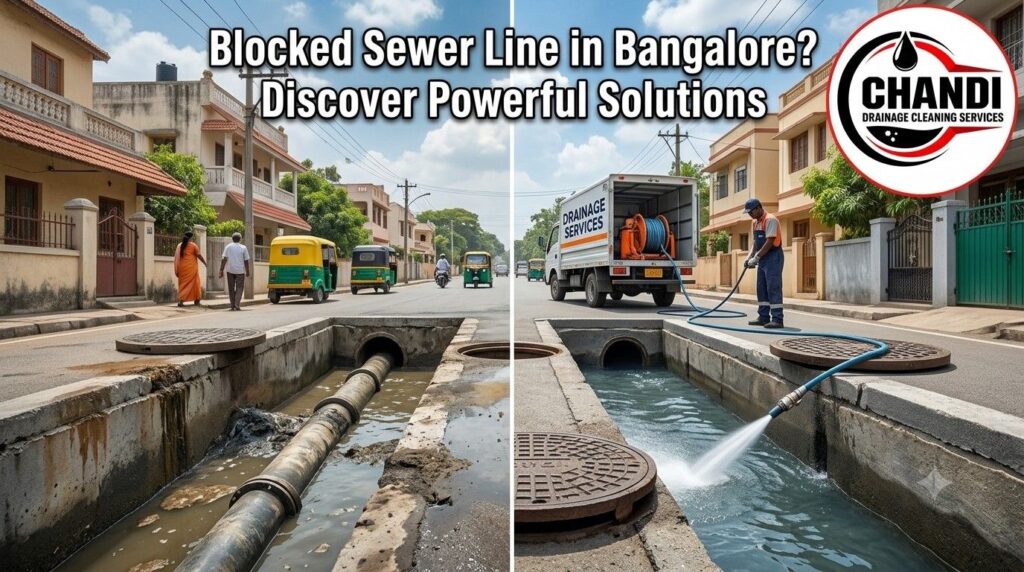
Cleaning a sewer line follows five steps: assessment, pumping out, jetting, flushing with a flow test, then disposal. Suction and high-pressure water do the work, so nobody has to climb into the pipe.
- Assess. The crew lifts the chamber lids, traces the run and locates the point where the flow stops.
- Pump out. A sealed suction tanker removes the standing sludge before any jetting starts.
- Jet. High-pressure water cuts through the hardened deposit and pushes it clear.
- Flush and test. Water runs through the whole line while the crew watches each chamber.
- Dispose. The tanker carries the waste to an approved disposal point.
Sewage pipe cleaning only works when suction comes first. Jetting into a full pipe simply pushes waste further down the run, so the crew empties the standing sludge before the nozzle goes in.
How Much Does Sewer Cleaning Cost In Bangalore?
Sewer cleaning is priced after a free inspection, because sludge volume, pipe length and chamber access differ on every job. A standard residential drain line starts from ₹500, and tanker trips add to the price of a full sewage line.
| What changes the price | Why it matters |
| Volume of sludge | A bigger load means more tanker trips and a higher bill |
| Pipe length and width | Longer, wider runs take more time on the jet |
| Chamber access | Cemented or buried lids add labour |
| Time of the visit | Night and holiday call-outs carry a different rate |
You get a figure before work starts, and the inspection itself carries no charge. For smaller jobs, see the starting rates on our drainage cleaning service page.
A fair quote names the job, the machines and where the waste will be taken. If a price arrives without an inspection, treat it as a guess, because no one can judge sludge volume from a phone call.
How Often Should You Schedule Sewer Cleaning?
Once a year suits most Bangalore homes, but a busy sewer line in a restaurant, PG or apartment block needs a clean every three to six months. Grease, heavier use and shared pipes make blockages return faster in those buildings.
Schedule the clean ahead of the monsoon. Heavy rain finds every weak spot in a line that is already half full, and an emergency visit during a storm costs more than a planned one.
Book sooner if:
- A tree grows close to the buried pipe
- Several floors share one line
- The last clean was more than a year ago
- A kitchen or hostel sends heavy grease down the drain
How Do You Pick A Safe Sewer Cleaning Contractor?
Choose a crew that inspects first, quotes before starting and works with suction and jetting machines. Hazardous manual cleaning of sewers is banned in India, so a contractor who offers to send a worker into the line is breaking the law.
The Prohibition of Employment as Manual Scavengers and Their Rehabilitation Act, 2013 came into force on 6 December 2013. Section 7 prohibits hazardous cleaning of sewers and septic tanks. You can read the official Act and related rules published by the National Commission for Safai Karamcharis.
Chandu Drainage Cleaning Services brings our team’s 20 years of experience and a client list of more than 250 to every job, and it guarantees 100% customer satisfaction.
Ask any contractor three questions:
- Do you inspect and quote before starting?
- Which machines do you use, suction, jetting, or both?
- Where is the waste taken after the cleaning?
Frequently Asked Questions
What causes a sewage blockage?
Grease, hair, silt, sanitary waste and construction debris settle and harden over time. Heavy solids drop out at chambers first, so a choked chamber is a common starting point.
Can a blocked pipe flood my house?
Yes. Once a blocked sewer line fills the chamber, the next outlet is often a floor trap on the lowest level, so call as soon as water nears the lid.
Do you clean at night or on Sundays?
Yes. We attend overflows the same day, including nights and Sundays, though night and holiday call-outs are charged differently.
Do you need to dig up the yard to clear a blocked pipe?
Not usually. The crew works through the chambers with suction and jetting, so digging is only needed when a pipe or chamber is broken and needs masonry repair.
Does a full chamber mean the pipe is blocked too?
Not always. Jetting the pipe without emptying the chamber sends waste straight back, so the crew checks both before closing the lid.
Do you offer yearly contracts for apartments?
Yes. Apartment associations and commercial properties can set a scheduled cycle, so lines are cleared before they choke.
Ready To Book A Sewer Clean?
Send us a photo of the open chamber and a note on where waste is rising, and we will tell you which job it needs. Contact us for a free quote, or call or WhatsApp 9900822778 to book a sewer line clean in Bangalore.
We work from Rajarajeshwari Nagar in Bangalore South, at 53 New #429 7th Cross, Banagappa Nagar, and attend jobs across the city.