
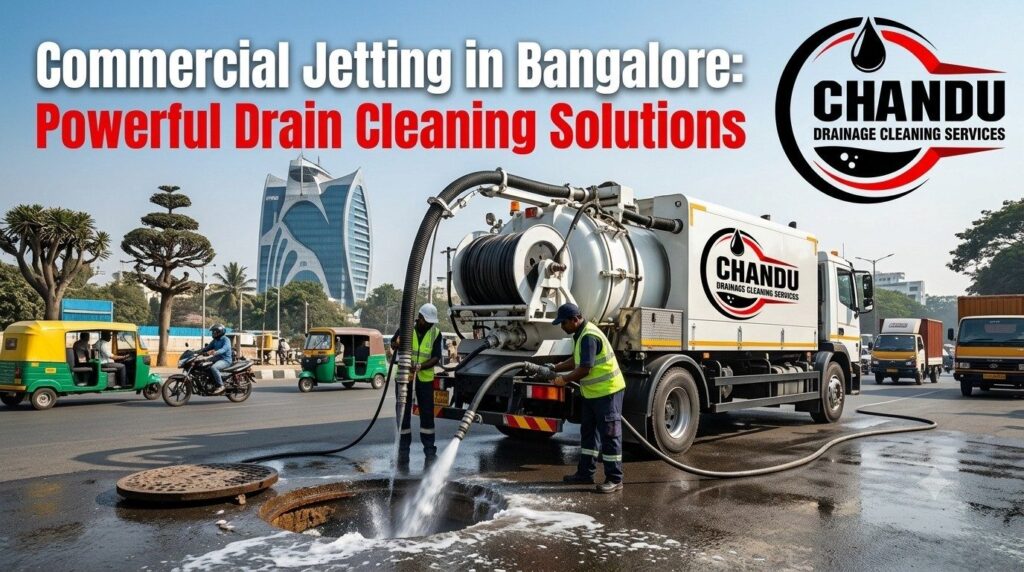
Understanding Commercial Drain Jetting in Bangalore
Commercial jetting uses high-pressure water to clear grease, silt, and hardened deposits from the drains of restaurants, hostels, apartment blocks, and factories. Chandu Drainage Cleaning Services offers it across Bangalore, with basic lines from ₹500 and larger commercial lines quoted after a free inspection.
A blocked home drain is an inconvenience. A blocked kitchen or hostel line stops trade, upsets tenants and invites a health complaint. This guide explains how business-scale work differs, what it costs, and how often it is to book it. Homeowners can start with our residential drain jetting guide.
At A Glance
- Price: From ₹500 for a basic drain line, with commercial lines quoted after inspection
- Response time: Same-day visits across Bangalore, emergencies included
- Areas covered: All of Bangalore, operating from Rajarajeshwari Nagar in Bangalore South
- Included: Inspection, jetting, flushing and a flow test
- Suggested cycle: Every 3 to 6 months for restaurants, PGs, hostels and apartment blocks
What Is Commercial Jetting and How Does It Differ from a Home Drain Clean?
Commercial jetting is draining cleaning scaled up for businesses: wider pipes, heavier grease and silt loads, and shared lines that serve many users at once. The method matches the one used at home, but the planning, access, and booking rhythm are not the same.
Four differences matter most when a business books the work:
- Pipe size and length. Business lines run wider and longer, so the crew plans the whole run before the hose goes in.
- Daily load. Kitchens, laundry and bathrooms push grease, lint, hair and soap into the same line from morning to night.
- Shared lines. One blockage can back waste into several shops, flats or rooms together.
- Cost of waiting. A shut kitchen or a flooded hostel corridor costs more than the cleaning would have.
Hydro jet cleaning is simply another label for this method, alongside pressure jetting and power jetting. Our water jetting guide with costs explains how the names overlap, so you can read any quote without confusion.
Homes can wait for a slow sink to become a blockage. A business rarely can, because the first symptom is often a smell in the dining room or water at a tenant’s door. Catching the problem on a schedule is the whole point of the service.
Which Businesses Need Jetting Most, And How Often?
Restaurants, PGs, hostels, apartment blocks, hotels and factories gain the most from commercial jetting, because heavy daily use lets deposits build quickly. A cycle of every 3 to 6 months suits most of them, with busy kitchens at the shorter end.
| Property | What builds up in the line | Suggested cycle |
| Restaurant or canteen | Cooking grease, food solids and soap | Every 3 months |
| PG or hostel | Hair, soap scum and laundry lint from heavy daily use | Every 3 months |
| Apartment block | Silt and waste in shared lines serving many flats | Every 4 to 6 months |
| Industrial or commercial unit | Long runs and constant use | Every 3 months or as usage demands |
| Any property | Monsoon debris and silt | One clearance before the rains |
These cycles follow the schedule our crews use for chambers, and the 3-to-6-month range matches what we advise for drain lines. Treat them as a starting point, then adjust once the first inspection shows how fast your line fills.
The Kitchens have different enemies. Oil that runs freely from a hot pan stiffens as it cools in the pipe, and each service day adds another thin layer until water struggles to pass.
Apartment blocks follow another logic. When the ground floor floods first, the fault usually sits in the shared line below, so cleaning one flat pipe changes nothing.
How Does Hydro Jet Cleaning Work Inside a Business Drain?
Hydro jet cleaning feeds a hose with a shaped nozzle through the pipe and fires pressurised water on the walls. The jet scours grease and silt off the full bore of the pipe and carries it to a point where it can be lifted out.
Three parts do the work: a pump that builds pressure, a hose that carries it into the line, and a nozzle that shapes the stream. The nozzle rear jets draw the hose forward while its front jets break the deposit ahead.
Business drains often end at a chamber loaded with settled waste, and jetting into a full chamber only moves the problem along. The crew empties it first with suction, then flushes the line. Our chamber cleaning service covers that step in detail.
Jetting has limits, and a good crew tells you where they are before work begins:
- Jetting clears: grease, silt, hair, hardened soap and roots that have grown into the line
- Jetting cannot fix: a cracked, collapsed or wrongly sloped pipe, which needs repair first
Roots are the clearest example. The jet trims them, but the crack they entered through stays open, so they regrow until the damaged section is replaced. The masonry and civil team quotes that repair separately from the cleaning.
The Prohibition of Employment as Manual Scavengers and their Rehabilitation Act, 2013 bars hazardous manual cleaning of sewers and septic tanks. The crew therefore works with suction and jetting machines and protective gear. Never climb into a chamber yourself, since the air inside can be unsafe to breathe.
Is A Scheduled Jetting Cycle Better Than Waiting For A Blockage?
For most businesses, yes. A scheduled commercial jetting cycle clears lines before they choke, so the work lands on your calendar instead of in the middle of service. Waiting only looks cheaper until the first overflow.
| Scheduled cycle | Waiting for a blockage | |
| Timing | Planned in advance with the crew | Whenever the line fails |
| Disruption | Short and expected | Sudden, often mid-service |
| Smell and complaints | Cleared before customers notice | Show up before anyone calls |
| Audit readiness | A regular cleaning pattern to show | Little to show an inspector |
| Cost pattern | Predictable visits | Emergency call-outs, priced by visit time and equipment |
A cycle also gives you a baseline. After two or three visits you can see how quickly your line fills and move the interval up or down, instead of guessing.
Associations and business owners who want fewer surprises can ask the team for a fixed visit pattern. Call 9900822778, describe the property and the cycle you have in mind, and the team will talk it through.
Do Food Safety Rules Affect How Restaurants Keep Drains Clear?
Indirectly, yes. The FSSAI hygiene rating checklist for restaurants score drain built for expected flow loads with grease and cockroach traps and expects no standing water in food zones.
The checklist runs 122 points, and the drain item is one line among many. It sets no jetting interval, so treat the cycle in this guide as maintenance advice, not a legal requirement.
Traps and jetting do different jobs. A trap catches grease near the kitchen, while jetting clears the deposits that still reach the pipe. A choked line also works against the standing-water point, since water backing up onto a kitchen floor is standing in water in a food zone.
How Much Does a Jetting Service Cost for a Business in Bangalore?
A basic drain line starts at ₹500, and commercial lines are quoted after a free inspection. The price follows pipe diameter, grease load, access, the floors and chambers served, and the time of the visit.
Commercial jetting is quoted by the job because no two business lines match. A basic home line is easy to price, but a restaurant, hostel or factory run depends on what the crew finds at inspection.
Five things move the figure:
- Pipe diameter and length: wider, longer runs need more jetting time
- Grease load: a heavily fatted kitchen line takes longer to scour
- Access: restricted chambers add time and labour
- Floors and chambers served: a tall block has more points to open
- Time of visit: night and holiday callouts are charged differently
The inspection is free, and the quote comes before any work starts, so you can compare it with other offers before committing. Chandu Drainage Cleaning Services brings 20 years of experience and 250+ clients, as the about page for the team shows.
Ownership of the machines matters too. Because the crew uses its own jetting equipment rather than hired-in help, one team stays accountable from inspection to flow test.
What Happens During a Commercial Jetting Visit, Step by Step?
A commercial jetting visit has six steps: briefing, inspection, suction where needed, jetting, flushing, and a flow test. The crew confirms that water runs freely before leaving, and any waste lifted from chambers goes out in a sealed tanker.
- Brief. Call or WhatsApp 9900822778 with the property type, the fixtures affected and a photo of the open chamber, taken from a safe distance.
- Inspect. Chambers are opened, and the line is traced to the spot where flow stops.
- Empty. Where a chamber holds settled waste, suction lifts it into the tanker first.
- Jet. The hose goes in, and the nozzle scours the pipe wall along the full run.
- Flush. The line is rinsed end to end, and loosened debris is carried to a chamber for removal, so it cannot rebuild a blockage further on.
- Test. Water is run from the fixtures upstream while the crew checks that it moves freely through the chamber.
The tanker takes lifted waste to an approved disposal point, so storm drains stay clear of it.
If waste is rising above the chamber lid or entering the building, the problem has outgrown a drain job. Our sewage cleaning service adds suction tankers to the jetting, with same-day attendance that covers nights and Sundays.
Until the crew arrives, switch off taps and washing machines on the affected line, keep visitors clear of pooled water and leave chamber lids closed.
Frequently Asked Questions
Is hydro jet cleaning the same as pressure jetting?
Largely, yes. Hydro jet cleaning, water jetting and pressure jetting are trade labels for the same pump, hose and nozzle method, so compare quotes by the work they list.
How often should a restaurant or hostel book drain jetting?
Every three to six months suits most restaurants, PGs, hostels and apartment blocks. Busy kitchens and full hostels sit at the shorter end, and a pre-monsoon visit beats an emergency call-out.
Can apartment associations book a regular cycle?
Yes, associations and business owners can ask the team to set up commercial jetting on a fixed schedule. Call or WhatsApp 9900822778 and describe the property.
Does the inspection cost anything?
No. The team inspects the line without charge and gives you a price before the work begins, with basic home lines starting at ₹500.
Will jetting fix a cracked or collapsed pipe?
No, because jetting cleans what sits inside a pipe, not the pipe itself. A damaged line needs repair first, and the masonry and civil team quotes that work separately.
Is a jetting service available outside Rajarajeshwari Nagar?
Yes. The team works from Rajarajeshwari Nagar in Bangalore South and visits properties across Bangalore, with same-day visits.
How Do You Get Started?
Call or WhatsApp 9900822778 with your property type and what is backing up, then request a free quote on our contact page. The crew inspects first, quotes before work starts and books about commercial jetting for the earliest visit.
Chandu Drainage Cleaning Services works from 53 New #429, 7th Cross, Banagappa Nagar, Rajarajeshwarinagar, Bangalore, Karnataka 560098, and covers all of Bangalore. You can also email info@chandudrainagecleaning.in.